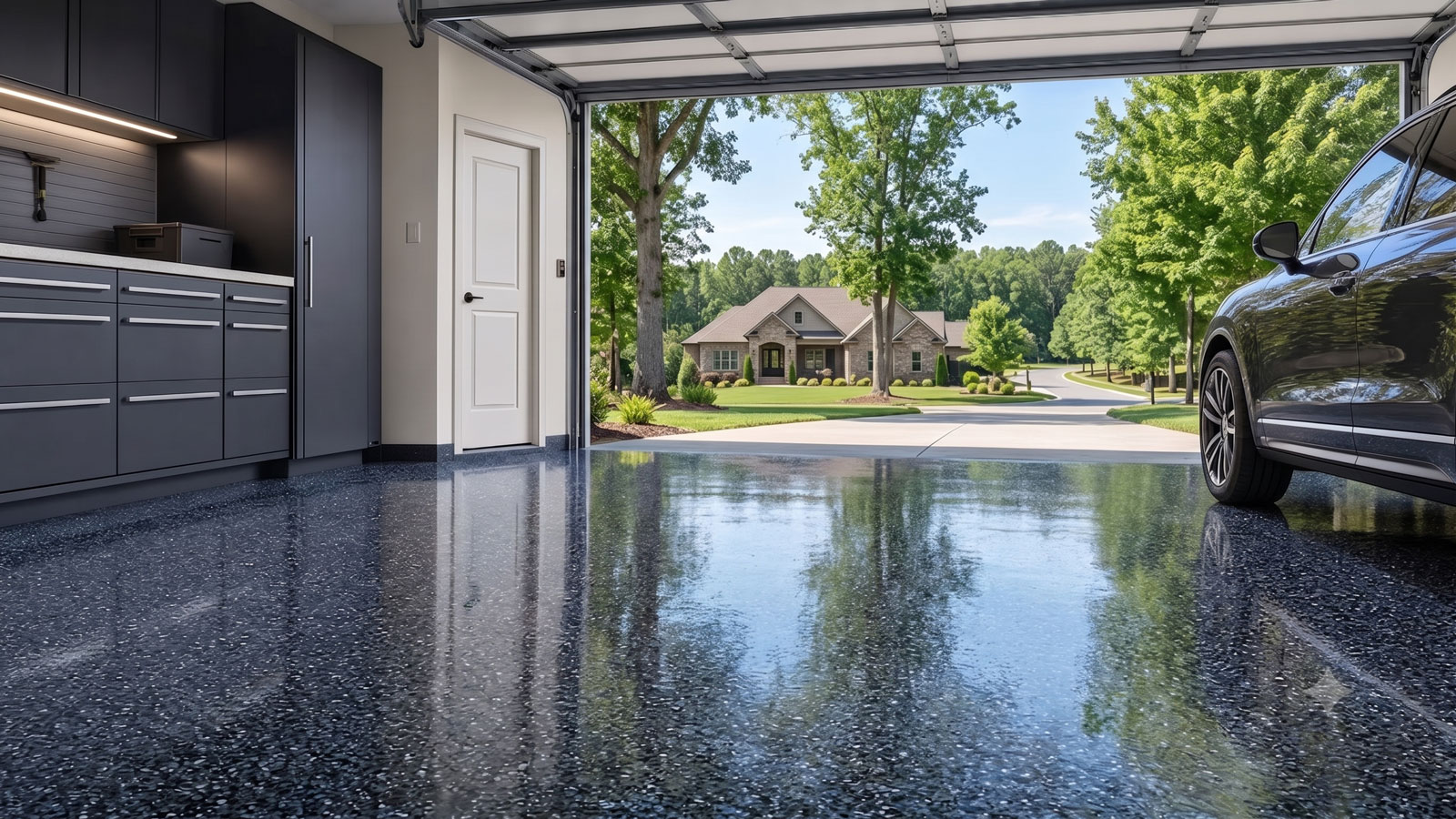
Garage Floor Coating in Centerton, AR
Garage floor coating planning for Centerton's expanding residential inventory.
Floor Coating Considerations in Centerton, AR
Centerton's development history is closely linked to westward growth from Bentonville, and its 2020 comprehensive plan formally includes a future land-use plan, a master street plan and a master trails plan. The municipal subdivision regulations connect that planning to how new land is developed. These are useful anchors for understanding why many neighborhoods have relatively recent residential construction, but no citywide description can prove the cure history or suitability of a particular garage slab.
Newer garages still require a methodical surface assessment. Construction dust, curing compounds, early hairline cracks, previous sealers and moisture all need consideration before an epoxy or polyaspartic system is installed. At the other end, an established garage already used for vehicle maintenance or workshop projects can carry old stains and coatings that affect grinding. The actual floor should drive the scope, not the age of the neighborhood on a real estate listing.
Centerton's location in the connected Bentonville-Rogers region also means daily garage use can be intensive for households commuting, storing recreational equipment and working around cars. A properly prepared coated floor can support easier cleaning, but the finish should be selected for traction, maintenance and realistic downtime. If rain enters at the threshold, address that grading issue separately rather than promising that a topcoat will make the garage waterproof.
Local Project Insight
Centerton adopted its comprehensive land-use framework in 2020, including future land use, a master street plan and trails planning. Its residential growth context warrants special attention to concrete cure history and new-construction residues, while actual floor testing—not a development date—controls coating readiness.
What Affects the Cost of Garage Floor Coating in Centerton?
Centerton garage quotes should distinguish a sound, properly cured surface from a slab requiring removal of construction treatments or repairs. Newness by itself is not an installed-ready specification.
The city's growth and subdivision pattern also make driveway access, two-bay layouts, storage and scheduling relevant, but the contractor must inspect these details at the specific property rather than presume all recent houses are interchangeable.
- Cure and construction history: On recently built properties, verify the concrete pour date, any curing compound and product moisture limits. A clean pale surface can still need grinding or additional waiting before a reliable coating installation.
- Existing sealer or builder treatment: Penetrating sealers and surface films can impair adhesion even if no paint is visible. Ask how the installer determines whether such treatments are present and what removal method is included.
- Cracks after occupancy: Small cracks and joints can develop in newer garages and should be examined for movement and repair options. Do not substitute decorative resin for needed structural evaluation.
- Driveway and door conditions: Subdivision layouts vary. Check whether exterior water accumulates at the garage entrance, whether a drain exists and how threshold preparation will be handled before quoting the coating.
- Vehicles, storage and staging: An attached garage used for daily parking and household storage needs room for equipment, cleaning and curing. Discuss who empties the garage and where vehicles can remain during the work.
- Flake coverage and finish: Full decorative-flake broadcasts, topcoat texture, color and cure-time requirements change cost and upkeep. Compare the installed system and preparation specification rather than a single product name.
Call for a clear, project-specific estimate — or request one online.
Centerton Growth and the Myth of a Coating-Ready New Slab
Centerton incorporated a comprehensive planning framework in 2020, covering future land use, streets and trails. Its subdivision regulations also reference the local Stormwater Management and Drainage Manual, identified as the 2009 edition or successor, and a master street plan adopted in November 2013. The planning area's development rules reach beyond city limits into specified surrounding territory. These separate documentary anchors demonstrate organized regional expansion alongside Bentonville, not that a specific garage slab was poured recently or treated with any one construction product.
Homeowners in newly occupied houses should ask whether a curing compound or sealer was applied and whether enough time has passed for the selected coating system. The answer depends on the actual concrete and the manufacturer's instructions. A contractor should evaluate moisture suitability, surface integrity and the mechanical profile needed before coating. A shiny or smooth finish from construction may be precisely what needs to be removed.
A garage with several years of use presents different questions. Tire marks, oil, stored tools and small repaired defects can all influence cleaning and grinding. The earlier a problem is identified, the easier it is to compare bids that describe the same preparation instead of one vague number.
An accurate proposal names the preparation method, intended coating layers and allowable return-to-service time. Ask what work is included if early grinding exposes a weak patch or incompatible surface treatment. This is how Centerton's construction variety translates into useful homeowner decisions rather than an assumption that all growing suburbs have perfect new concrete.
Subdivision Garages, Drainage and Everyday Use
Centerton's street and land-use plans show a community organizing new neighborhoods and transportation connections. For an individual garage, those larger plans are context, not moisture testing. Walk the actual property and note the driveway slope, roof drainage and whether rainwater ever crosses the garage threshold.
Where exterior water enters, determine what needs changing outside before a floor system is selected. A decorative coating cannot redirect water, stabilize soil or stop a moving crack. If the floor itself appears chronically damp, ask about suitable tests and product limitations. If there is no persistent problem and the concern is only water tracked from vehicles, cleaning and texture may be the practical topics instead.
Daily routines matter as much as the size on a builder's plan. A two-car garage used for bikes, lawn equipment, storage and parking can need careful edge work and a finish chosen for moving equipment. Homeowners should inspect examples of smooth and textured flake finishes and ask how each responds to dirt and cleaning.
Installation requires the whole garage to be cleared, the slab prepared and the new surface left alone for its recommended cure period. Compare realistic schedules for epoxy and polyaspartic systems after the substrate has been evaluated. Speed is helpful only when it follows—not replaces—the required preparation and repair steps.
Frequently Asked Questions
Can a brand-new Centerton garage be coated immediately?
Not necessarily. Verify the slab's cure history, moisture condition and any curing compounds or sealers. A contractor should confirm the concrete meets the selected coating system's instructions before installation.
Does a newer subdivision guarantee a crack-free floor?
No. Cracks and joints may need attention regardless of construction date. The important questions are whether the concrete is sound, whether any crack is moving and what repairs are appropriate.
Can the coating compensate for water entering through my garage door?
No. Grading, gutter discharge or threshold problems require their own correction. Once active water entry is addressed, assess the concrete itself before installing a finish.
Is a decorative flake coating useful for a garage full of household gear?
It can be, when properly prepared and installed, but choose texture with cleaning and intended use in mind. Move stored items first so hidden damage and contamination can be inspected.
Which estimate details matter most in Centerton?
Look for verification of concrete readiness, grinding, removal of treatments, crack work, coating layers, perimeter detailing and cure restrictions. Be wary of bids that price only square footage without describing preparation.
Centerton Neighborhoods & Local Context
Phone Quote Line
Discuss your project and get a realistic estimate range for the garage.
(479) 777-2577Typical Project Cost
$3,000–$5,500
Typical range for a two-car garage. Final pricing depends on floor size, concrete condition, preparation, coating type, and finish options.
Helpful Guides